How Much Does an HRIS Really Cost? (2026 Pricing Guide)
Let's be honest: when you start shopping for an HRIS, the pricing feels like trying to buy a car where nobody posts the sticker price. You get "request a quote" buttons, vague ranges, and the dreaded "it depends."
Well, it's 2026, and we've worked on 100+ HRIS projects. We've seen the invoices, the surprise fees, and the "oh, that's extra?" moments. So let's cut through the sales fog and talk about what an HRIS actually costs, and more importantly, what you're really paying for.
The Base Cost: Understanding PEPM Pricing
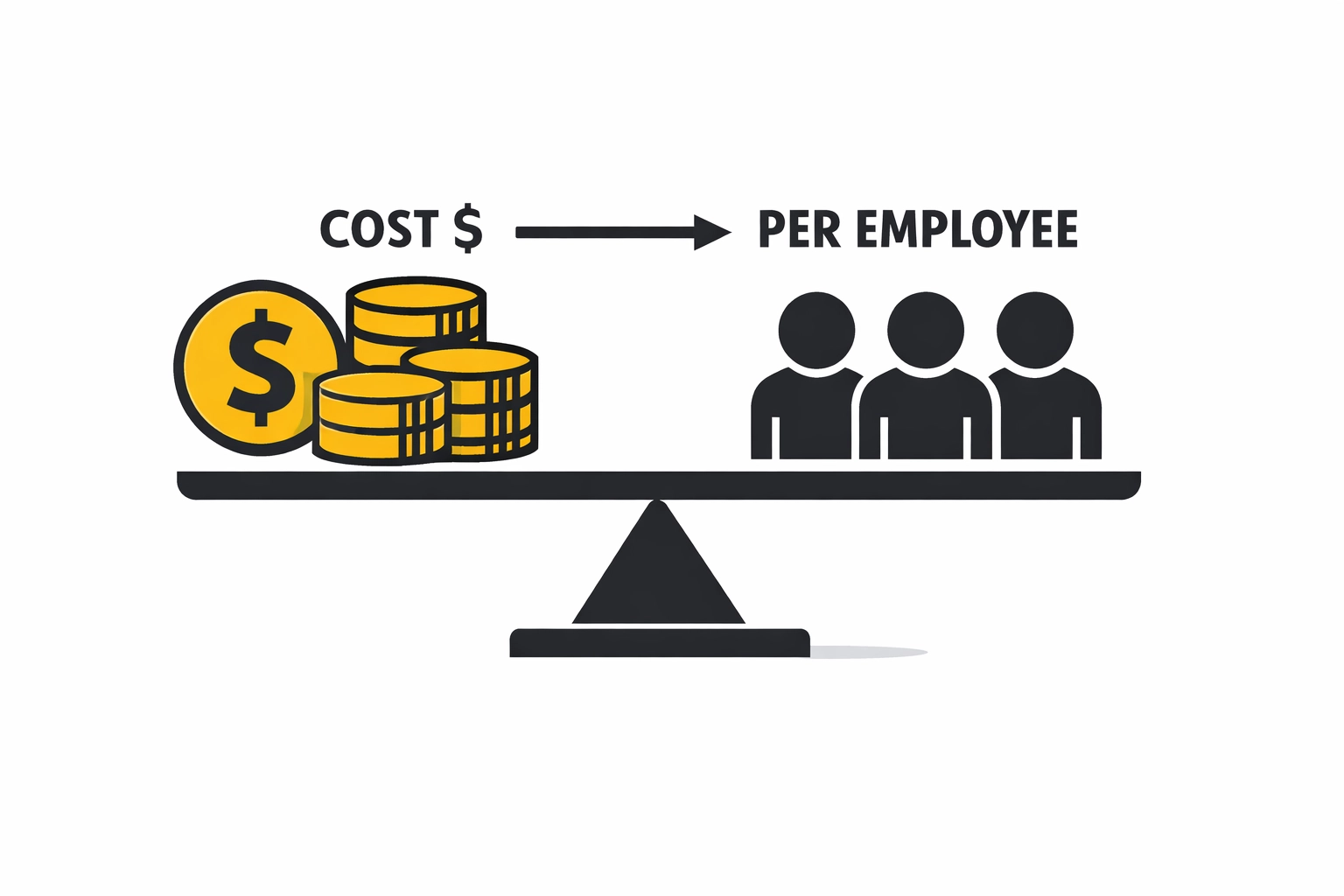
Most HRIS platforms charge on a per-employee-per-month (PEPM) basis. Think of it like a gym membership that scales with your headcount.
Here's what the market looks like in 2026:
Small businesses (under 50 employees): $6–$12 PEPM for core functionality. Some lightweight platforms start as low as $4 PEPM if you're willing to skip the bells and whistles. A few even offer free plans for teams under five people, though you'll quickly outgrow them.
Mid-market (50–500 employees): $12–$35 PEPM. Most platforms in this range charge a base fee ($50–$100/month) plus the per-employee rate. So if you have 100 employees, you're looking at $1,200–$3,600 per month.
Enterprise (500+ employees): $34–$42 PEPM and up. At this level, you're getting comprehensive HCM suites with all the fixings. But "and up" is doing a lot of work in that sentence, customization can push these numbers way higher.
Real Platform Examples
Let's make this concrete. Here's what some popular platforms actually charge:
BambooHR: $250/month flat for up to 25 employees (nice and simple). Beyond that, you're getting a custom quote.
Rippling: $8–$9 PEPM with a modular approach. Want payroll? That's extra. Want benefits admin? Also extra.
Gusto: $49–$180/month base fee, plus $6–$22 PEPM depending on your tier.
HiBob: $16–$25 PEPM for their mid-market sweet spot.
ADP Workforce Now: $23–$30 PEPM for software-only, or $35–$55 PEPM if you want their service team involved.
Workday: $34–$42 PEPM. (Spoiler: this is just the beginning for Workday.)
The PEPM rate tells you the monthly cost, but it's nowhere near the full picture.
Implementation Fees: The Upfront Reality Check
Here's where things get spicy.
That shiny new HRIS doesn't just magically turn on. Someone needs to configure it, map your org structure, set up workflows, and connect it to your other systems. Implementation fees cover that work, and they range wildly.
Small business tools: A few hundred to a couple thousand dollars. These are often self-service setups with some vendor support.
Mid-market platforms: $5,000–$25,000 depending on complexity. You're getting dedicated implementation managers, training sessions, and data migration support.
Enterprise solutions: Six figures is the norm. Workday implementations? $300,000–$800,000. Yes, you read that right. And that's before you start customizing.
Why so expensive? Because enterprise implementations involve change management, custom integrations, detailed reporting builds, and months of configuration. You're not just buying software, you're buying a transformation project.
The lesson here: always ask about implementation costs upfront. It's the difference between budgeting $20K for an HRIS and realizing you need $50K.

Hidden Costs Nobody Mentions (Until You're Locked In)
Now we get to the stuff that doesn't show up on the sales deck.
Data Migration
Moving your employee data from spreadsheets, old systems, or multiple sources into your new HRIS isn't free. Clean data migration can cost $2,000–$10,000+ depending on how messy your data is. And trust us, it's always messier than you think.
Training
Your team needs to learn the new system. Most vendors include some basic training in the implementation fee, but ongoing sessions, custom training materials, or manager-specific workshops? That's usually extra. Budget $1,000–$5,000 for proper training support.
Premium Support Tiers
That $8 PEPM pricing? It probably includes email support with a 24-48 hour response time. Want a dedicated account manager or same-day phone support? Upgrade to the premium tier for another $3–$5 PEPM.
Add-On Modules
The base HRIS price typically covers core HR functions: employee records, time-off tracking, maybe basic reporting. But what about:
Performance management? Add $2–$4 PEPM.
Applicant tracking? Another $3–$5 PEPM.
Advanced analytics? $2–$6 PEPM.
API access for integrations? Could be free, could be thousands annually.
Suddenly that $10 PEPM base price is $22 PEPM for what you actually need.
The Cost of Doing Nothing: Why Spreadsheets Are Expensive
"We'll just stick with Excel and Google Sheets" sounds budget-friendly until you calculate what it's really costing you.
Lost time: Your HR team (or office manager, or whoever drew the short straw) spends hours each week updating spreadsheets, chasing down approvals, and manually tracking PTO. At $35/hour, that's $7,280 per year per person doing manual HR admin. For a 50-person company, that's easily 10-15 hours a week of wasted time.
Compliance risks: Missed meal break penalties in California? $100+ per violation per day. Miscalculated overtime? Back pay plus penalties. One wage-and-hour lawsuit can cost $50,000–$150,000 to defend, even if you win.
Employee experience: Your team has to Slack someone to request PTO, wait for approval, and hope it gets logged correctly. They can't see their pay stubs easily. New hires get paperwork packets instead of digital onboarding. That friction costs you in morale and retention.
When you actually add it up, not investing in an HRIS often costs more than buying one. The question isn't whether you can afford an HRIS, it's whether you can afford not to have one.

Best-of-Breed vs. All-in-One: The Pricing Trade-Off
You've got two approaches to HRIS shopping, and they have different cost profiles.
All-in-one platforms (BambooHR, Namely, Rippling with all modules) bundle everything: HRIS, payroll, benefits, time tracking, ATS, performance management. The pitch is simplicity and one monthly bill. Pricing is higher upfront ($15–$25 PEPM fully loaded), but you avoid integration headaches.
Best-of-breed approach means picking specialized tools: Gusto for payroll, BambooHR for HRIS, Greenhouse for ATS, Lattice for performance. Each tool is best-in-class for its function. You might pay $8–$12 PEPM across all tools, but you'll spend more on integrations and deal with multiple vendors.
For companies under 100 employees, all-in-one usually wins on total cost of ownership. You don't have the HR team bandwidth to manage five vendor relationships and troubleshoot integration issues.
How JHHR Helps You Avoid Overpaying
Here's the thing: HRIS vendors are incentivized to sell you their most expensive tier with all the modules. It's how they hit quota.
But here's what we've learned from 100+ implementations: most small businesses use about 60% of what they pay for.
That's where an independent consultant like JHHR makes a real difference. We:
Right-size your requirements. We help you separate "must-haves" from "nice-to-haves." That performance management module sounds great, but if you're doing annual reviews on a simple form, do you really need a $4 PEPM tool for it?
Negotiate better pricing. We know the market rates and which vendors have flexibility. We've saved clients 15-30% on their final contracts just by knowing what's negotiable.
Avoid implementation pitfalls. Those $300K enterprise implementations? A lot of that cost comes from scope creep and poor planning. We keep projects on track and on budget.
Find hidden cost savings. Sometimes the answer isn't a new HRIS, it's better use of what you already have, or a simpler tool that costs half as much.
We're not on commission from any vendor. We get paid to find you the right solution at the right price, not the most expensive one.
The Bottom Line on HRIS Costs
Here's your back-of-napkin budgeting guide for 2026:
For a 25-person company: $3,000–$6,000 for implementation, $150–$300/month ongoing (including a couple key modules). Total first-year cost: $5,000–$10,000.
For a 75-person company: $10,000–$20,000 for implementation, $900–$2,000/month ongoing. Total first-year cost: $21,000–$44,000.
For a 150-person company: $25,000–$50,000 for implementation, $3,000–$5,000/month ongoing. Total first-year cost: $61,000–$110,000.
Yes, those are real numbers. And yes, an HRIS is a significant investment.
But so is doing nothing. The question isn't whether you can afford an HRIS: it's whether you're ready to stop losing money on inefficient processes, compliance risks, and manual busywork.
If you're trying to figure out what's right for your budget and your team, let's talk. We'll help you understand the real costs, find the right-sized solution, and make sure you're not overpaying for features you'll never use.
Comments